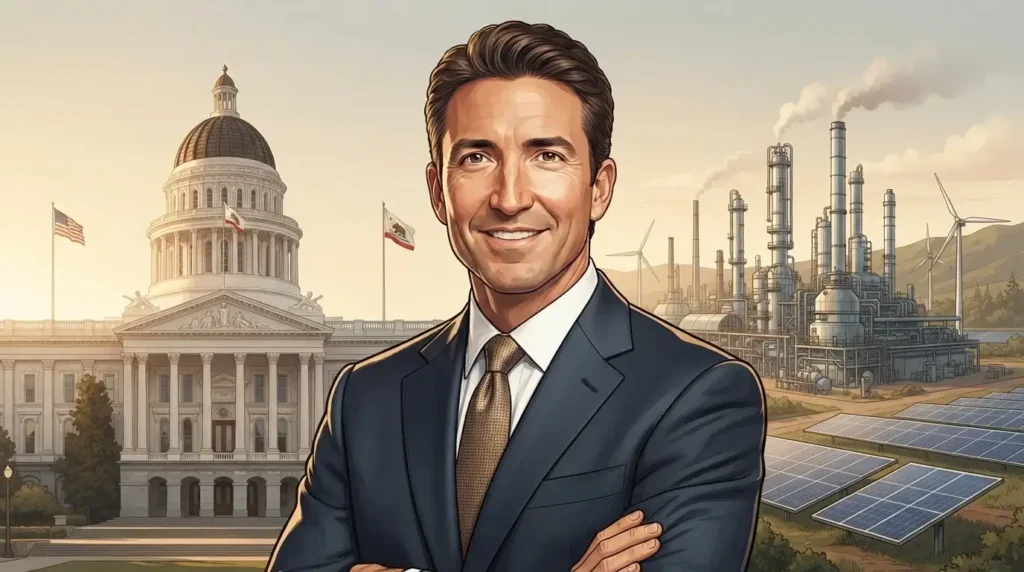
If you’ve come across the name Michael Rubio, there’s a good chance it was in one of two contexts — California politics or the energy industry. That’s because they’re the same person. Rubio spent his early career climbing the ranks of Kern County and state government – then walked away from elected office to build a different kind of influence – this time from inside one of the world’s largest energy companies.
His story is worth understanding whether you follow California politics – track the energy transition or simply want to know how public policy experience shapes private sector leadership.
Early Life and Education of Michael Rubio
Rubio grew up in Kern County, California. He worked his way through Bakersfield College before heading east to study Justice Administration at the University of New Haven in Connecticut – where he graduated with honors in Criminology. It’s not the background you’d immediately associate with energy legislation — but it points to a pattern that shows up throughout his career: Rubio consistently moves into spaces he wasn’t originally trained for and builds expertise from the inside out.
He later added an executive education credential – completing the Senior Executives in State and Local Program at Harvard University’s John F Kennedy School of Government — a program commonly used by public officials preparing for broader leadership roles.
Before entering politics Rubio worked for the US Department of Justice – then returned to Kern County as an advocate for youth and later led an agency that provided health insurance to underprivileged children. He also spent four years in Sacramento working for State Senator Dean Florez, where he focused on air quality in the San Joaquin Valley, fought against the dumping of sewage sludge from Los Angeles into Kern County, and worked on education policy. That stretch gave him his first real exposure to environmental and regulatory issues — the same issues that would follow him throughout the rest of his career.
Getting His Start: Kern County Board of Supervisors
In March 2004 Rubio won a seat on the Kern County Board of Supervisors, representing the Fifth District – the communities of Arvin, Lamont and East Bakersfield. At the time he became the youngest elected supervisor in California history.
His tenure on the board was defined by two major efforts. First he authored the Kern County Gang Violence Strategic Plan – which tripled the Sheriff’s Gang Unit and helped create mentoring and after school programs aimed at steering young people away from gangs. Second — and most relevant to where his career went next — he spearheaded the Kern County Renewable Energy Initiative, which helped pave the way for some of the largest solar and wind projects built in California.
That combination of public safety work and energy policy gave a clear preview of where things were headed.
The California State Senate (2010–2013)
In November 2010 Rubio was elected to the 16th State Senate District – representing portions of Fresno, Kern, Kings and Tulare counties. At that time he was the youngest sitting member of the California State Senate.
He worked in Sacramento as a member of and chair of several Senate Budget and Fiscal Review Committee subcommittees – including Agriculture (Vice Chair), Energy, Utilities and Communications, Health, Transportation and Housing and Veterans Affairs. The Senate Committee on Environmental Quality, which put him in the middle of arguments about how California should protect the environment while also growing its economy.
As they were in Kern County, jobs, water access for the San Joaquin Valley and changes to energy permits. He introduced SB 16 to streamline the approval process for renewable energy projects and became one of the Senate’s most vocal advocates for reforming the California Environmental Quality Act (CEQA) – preserves the environment and others say makes it excessively tough to build anything in the state.
In February 2013, Rubio resigned his Senate seat. The public reason he gave at the time was spending more time with his family — he famously said he had “missed too many family dinners, bedtime stories and parent-teacher conferences.” Something happened that clarified the whole scenario.
The Move to Chevron
Within days of his resignation, Rubio joined Chevron Corporation. He started as Manager of State Government Affairs, covering California, Oregon and Washington — directly applying the legislative relationships and regulatory knowledge he’d built in Sacramento to a corporate government affairs role.
Over the next several years, he moved up through the organization. Director of Sustainability (ex General Manager ESG and Sustainability in March 2022). Shareholders and other important people at Chevron about ESG issues, the company’s climate policy and its decarbonization portfolio. They work closely with top Chevron executives to shape the company’s sustainability strategy.
Rubio has become one of the most public faces of Chevron on sustainability. In 2023, he keynoted the New York Energy Capital Assembly at the NYSE, addressing more than 100 institutional investors about Chevron’s approach to achieving what the firm calls “Higher Returns, Lower Carbon” plan compared to European energy majors, the challenges investors face in assessing long term energy transition strategies and the steps he believes investors should take to assess the authenticity of a company’s climate pledges.
Chevron’s Sustainability Direction Today
Understanding Rubio’s role requires knowing where Chevron currently stands on sustainability — and it’s a more nuanced picture than critics and supporters on either side tend to acknowledge.
Chevron has promised to put $10 billion into projects – that reduce carbon emissions until 2028. To cut the amount of greenhouse gases (GHG) in oil and gas by 35% from 2016 levels by 2028. It has already surpassed its earlier upstream carbon intensity goals for 2023, finishing three years early. Plant in Geismar, Louisiana in 2025. At full capacity it could produce 22,000 barrels of diesel a day.
At the same time Chevron remains a major fossil fuel producer – and its ESG ratings reflect that tension. The company has drawn ongoing scrutiny from environmental groups and its own SEC filings acknowledge significant uncertainty around the pace and direction of the global energy transition.
Rubio sits squarely in the middle of that tension — communicating Chevron’s sustainability story to investors and regulators while the company navigates a global energy landscape that is shifting, but not as quickly or as well as many had hoped.
Energy and real estate development often reflect the same policy pressures. For a closer look at how major approvals are reshaping urban landscapes in 2025, see our coverage of the Trump Miami Development Approval 2025: Impact on City & Real Estate.
Why Michael Rubio Career Path Is Worth Paying Attention To
Rubio’s trajectory is a good example of something that happens more often in energy and infrastructure than most people realize: policymakers who spend years writing the rules eventually go to work for the companies those rules govern. It’s not unique, but it is instructive — because it illustrates how someone with deep legislative experience in renewable energy and environmental permitting can carry that knowledge into a Fortune 500 sustainability function.
Whether you view that kind of move as a natural and valuable progression or as a conflict of interest probably depends on your politics. Rubio has spent more than 20 years working on mostly the same set of issues, energy, the environment and rules. First he did this while working for the California government and now – he does it for one of the companies that is most affected by the policies he helped make.
Frequently Asked Questions About Michael Rubio
Michael Rubio is a former California State Senator who represented the 16th Senate District from 2010 – until his resignation in February 2013. He was the Fifth District Kern County Supervisor and is now Chevron’s Director of Sustainability.
Rubio resigned in February 2013 – citing the toll the job had taken on his family life. He accepted a role at Chevron Corporation almost immediately after stepping down.
Since March 2022 he has served as Chevron’s Director of Sustainability. ESG plan and shareholder talks – essential people regarding climate policy and decreasing carbon emissions.
Environmental Quality Act (CEQA) and he proposed SB 16 to make it easier for renewable energy projects – to get permits. He also chaired the Senate Committee on Environmental Quality.
Chevron’s stated approach is Higher Returns Lower Carbon. It’s a strategy to minimize carbon intensity across its activities – while remaining profitable. The company has committed $10 billion to lower carbon projects through 2028 and set a net zero emissions target for 2050.